




Blog
How Long Does Perfume Last? Skin Wear Time vs. Shelf Life

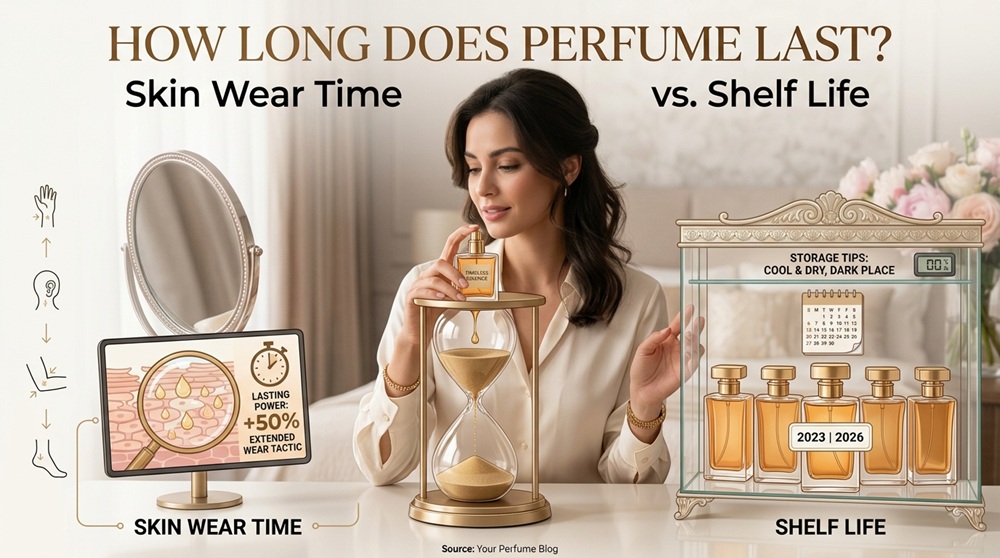
Whether you want to know how many hours your fragrance will last on your skin after spritzing, or whether that forgotten bottle at the back of your vanity has expired, understanding fragrance longevity comes down to two distinct factors: wear time and shelf life.
This guide covers the shelf life of opened perfume, how to identify an expired bottle, and the science of maximizing skin projection.
Quick Answer: Perfume Longevity at a Glance (Featured Snippet)
- Shelf Life in the Bottle: Unopened perfumes last 3 to 5 years. Once opened, most fragrances remain stable for 12 to 36 months, depending on storage conditions and ingredient composition.
- Wear Time on Skin: Varies by concentration—Eau de Toilette (EDT) lasts 3 to 5 hours, while Eau de Parfum (EDP) lasts 6 to 8+ hours.
- How to Tell if It’s Expired: Look for a sour or vinegar-like scent, liquid discoloration, or an expired PAO (Period After Opening) symbol on the packaging.
Table of Contents
Perfume Wear Time vs. Bottle Shelf Life
Does Perfume Expire? The Chemistry of Fragrance Decay
- Chemical Oxidation from Air Exposure
- Thermal Degradation from Temperature Spikes
- UV Light Breakdown of Essential Oils
- Natural vs. Synthetic Stability Profiles
How to Tell If Your Perfume Has Expired (4 Key Checks)
10 Pro Tips to Make Your Perfume Last Longer on Skin & In Bottle
Frequently Asked Questions (FAQ)
Conclusion
Perfume Wear Time vs. Bottle Shelf Life
To choose and care for your scents properly, it helps to distinguish between how long a fragrance performs on your body versus how long it stays fresh in the bottle.
| Metric | Wear Time (On Skin) | Shelf Life (In Bottle) |
| Primary Factor | Fragrance Concentration (EDT vs. EDP) & Skin Moisture | Storage Conditions, UV Exposure & Air Contact |
| Average Duration | 2 to 12 Hours | 1 to 5 Years |
| Key Indicator of End | Scent fades completely into base notes | Sour smell, discoloration, or altered dry-down |
| How to Extend | Apply to moisturized skin & pulse points | Store in a cool, dark drawer away from humidity |
Does Perfume Expire? The Chemistry of Fragrance Decay
Yes, perfume expires. While perfume doesn’t spoil like food or grow dangerous bacteria due to its high alcohol content (typically 70%–80% ethanol), its chemical structure breaks down over time through eight distinct environmental and molecular mechanisms:
1. Chemical Oxidation from Air Exposure
Every time you spritz a bottle, headspace air fills the empty chamber. Over time, oxygen molecules react with volatile aromatic compounds—especially light terpenes found in citrus top notes like bergamot, lemon, and mandarin—altering their molecular structure and producing a sharp, vinegar-like off-note.
2. Thermal Degradation from Temperature Spikes
Storing perfume in environments subject to fluctuating temperatures (like bathrooms) causes thermal expansion and contraction. Heat speeds up kinetic energy at the molecular level, breaking delicate ester and alcohol bonds far faster than room-temperature storage.
3. Photo-Oxidation from UV Light
Direct sunlight and ambient ultraviolet (UV) radiation act as catalysts for photo-chemical reactions. UV rays destroy chemical bonds in both natural essential oils and synthetic accords, turning clear liquids dark or yellow and flattening the top and heart notes within months.
4. Natural vs. Synthetic Stability Profiles
Perfumes rich in natural essential oils (especially cold-pressed citrus and delicate florals) lack long-term chemical stability. Conversely, heavy synthetic base notes like musk, amber, and vanillin act as natural preservatives, resisting oxidation for up to 5 years.
5. Hydrolysis from Ambient Humidity
High humidity and steam penetrate poorly sealed spray nozzles or splash bottles over time. Water molecules introduced into the fragrance solution trigger hydrolysis, causing fragrance esters to break down into their constituent acids and alcohols, souring the blend.
6. Volatilization & Loss of Top Notes
Alcohol acts as the volatile carrier for perfume oils. In poorly sealed bottles or atomizers with high evaporation rates, the alcohol and lightest top notes evaporate slowly off the top, leaving behind a thick, unbalanced, and heavy base profile.
7. Evaporation of Fixatives
Fixatives (such as oakmoss, resins, and synthetic wood compounds) are designed to slow down the evaporation rate of lighter notes. As these fixative molecules break down due to age or air exposure, the overall scent profile loses its structural balance and projection power.
8. Structural Breakdown of Essential Esters
The aromatic compounds responsible for pleasant floral and fruity nuances are primarily esters. Over time, organic acid accumulation within aging fragrance oil transforms these sweet esters into carboxylic acids, resulting in a distinctly sour, metallic, or stale aroma.
How to Tell If Your Perfume Has Expired (8 Key Checks)
1. Check the PAO (Period After Opening) Symbol
Look at the bottom of the perfume box or bottle for a small open-jar icon stamped with a number followed by an M (e.g., 12M, 24M, or 36M). This indicates the manufacturer’s official recommended shelf life in months once the bottle has been sprayed.
2. Check the Batch Code
Locate the 3 to 5-digit alphanumeric batch code stamped on the bottom of the bottle or box. Entering this code into a batch code calculator (such as CheckFresh or CheckCosmetic) reveals the exact month and year the fragrance was manufactured.
3. The Smell Test (Sour or Vinegar Off-Notes)
The most definitive test is your nose. Expired perfume loses its bright top notes and develops a sour, oxidized, vinegar-like, or plastic-like smell reminiscent of acetone or old cooking oil.
4. Visual Color Shifts
If a once-clear, pale yellow, or soft pink liquid turns dark brown, orange, or cloudy, the essential oils and dyes inside have undergone significant oxidation and photo-degradation.
5. Presence of Visible Sediment or Particle Separation
Hold the bottle up to a light source. If you notice floating particles, cloudiness, or a sticky residue settling at the bottom of the glass, the perfume oils have separated from the alcohol carrier.
6. Changes in Liquid Consistency & Sprayer Residue
Touch a drop of the liquid or inspect the spray nozzle. Expired perfumes often leave a sticky, thick, or oily residue around the atomizer cap as the alcohol content evaporates and leaves behind degraded oil resin.
7. Drastic Loss of Longevity
If a long-lasting Eau de Parfum that normally stays on your skin for 8 hours suddenly vanishes within 30 to 45 minutes, the aromatic compounds and fixatives have broken down completely.
8. Skin Sensitivity or Contact Irritation
Oxidized perfume components and degraded alcohol can disrupt your skin’s natural barrier. If spritzing your fragrance causes mild skin redness, itching, or an allergic reaction where you applied it, the bottle has passed its prime and should be discarded.
10 Pro Tips to Make Your Perfume Last Longer on Skin & In Bottle
- Keep It Out of the Bathroom: Store bottles in a dark bedroom closet or drawer where temperature and humidity remain stable.
- Keep the Cap Sealed: Always replace the cap tightly after spritzing to minimize air contact and oxidation.
- Moisturize Before Spritzing: Hydrated skin holds fragrance oils up to 50% longer. Apply an unscented body lotion or petrolatum jelly to pulse points before spraying.
- Target Warm Pulse Points: Apply to your wrists, lower neck, inner elbows, and behind the knees to utilize body heat for steady scent diffusion.
- Never Rub Your Wrists: Friction generates rapid heat that burns off volatile top notes prematurely. Let the spray dry naturally on your skin.
- Mist Your Hairbrush: Hair traps scent exceptionally well. Spritz perfume onto a hairbrush rather than directly on hair to avoid drying out strands with alcohol.
- Store in Original Packaging: If you display your collection on a vanity, keep bottles inside their original cardboard boxes to shield them from ambient light.
- Match Your Scents by Season: Light citrus scents evaporate quickly in cold winter air, while heavy gourmand or woody notes thrive in cooler temperatures.
- Buy Smaller Bottles for Rotation: If you rotate between many fragrances, opt for 30ml or 50ml bottles so you finish them before oxidation sets in.
- Use Batch Codes for Unopened Bottles: If buying vintage or secondhand perfume, check the batch code on a verification database (like CheckFresh) to confirm the manufacturing date.
So the Perfume Has Expired; What Do I Do Now?
Discovering that a favorite fragrance has passed its prime doesn’t mean it has to go straight into the trash. While you should refrain from spraying expired perfume directly onto your skin to avoid irritation or contact dermatitis, you can repurpose the bottle or dispose of it safely using several eco-friendly methods:
1. Repurpose It as a Room or Linen Spray
If the fragrance has only slightly shifted—losing its top notes but still retaining a pleasant heart or base aroma—use it as an ambient room mist. Spray it onto curtains, decorative rugs, soft furnishings, or inside closets and coat rooms to leave a subtle background scent. Always test a small hidden area first to ensure the oils won’t stain fabrics.
2. Craft a Scented Drawer Sachet or Potpourri
Spritz expired perfume onto unglazed ceramic diffuser stones, wooden closet rings, dried flowers, or cotton balls. Place them inside your dressers, shoe cabinets, or luggage containers to keep enclosed storage spaces smelling fresh without direct contact with your skin.
3. Transform the Bottle into Home Decor
High-end and artisanal perfume bottles are small works of art. Once emptied and rinsed with warm soapy water and isopropyl alcohol, upcycle the glass vessel into:
- A Mini Flower Vase: Perfect for single-stem buds or dried florals.
- A Reed Diffuser: Fill the clean glass with a carrier oil (like sweet almond oil), add a few drops of fresh essential oils, and insert bamboo rattan reeds.
- A Vanity Display Piece: Keep empty luxury bottles on a mirrored tray to add vintage charm to your dressing table.
4. How to Safely Dispose of Expired Perfume
Never pour large quantities of expired perfume straight down the sink or toilet. The high concentration of alcohol and concentrated fragrance oils can pollute local water systems and harm aquatic life. Instead, follow these proper disposal steps:
- Absorb the Liquid: Pour the remaining fragrance onto an absorbent, disposable material like cat litter, paper towels, or sawdust inside a sealable container or bag, then discard it in your standard household trash.
- Rinse & Recycle the Glass: Detach the plastic atomizer and metal collar using pliers. Wash out the glass bottle thoroughly, let it dry, and place it in your standard glass recycling bin.
Frequently Asked Questions (FAQ)
1. How long does perfume last unopened?
An unopened, properly stored bottle of perfume can last anywhere from 3 to 5 years (and sometimes up to 10 years for heavy resinous or woody fragrances) without losing potency.
2. Is it safe to use expired perfume?
While expired perfume is rarely toxic, degraded essential oils and oxidized alcohol can cause skin irritation, redness, or contact dermatitis. It is best to perform a small patch test on your forearm first.
3. Can you store perfume in the fridge to make it last longer?
Yes! Storing perfume in a dedicated, dark, cool refrigerator (kept at a steady temperature around 10°C–12°C) can significantly slow oxidation and extend shelf life—especially for citrus-heavy fragrances.
4. What should you do with an expired bottle of perfume?
Do not pour large amounts of perfume down the drain, as concentrated fragrance oils can impact aquatic life. Instead, dispose of the liquid according to local household waste guidelines, rinse the glass bottle, and recycle it.
5. Why does perfume smell different on different people?
Individual skin pH, natural lipid levels, diet, and body temperature alter how perfume notes evaporate, causing the same bottle to smell distinct on different individuals.
6. How many sprays of Eau de Parfum should I use?
For everyday wear, 2 to 4 sprays of Eau de Parfum applied to targeted pulse points delivers optimal projection without overwhelming those around you.
Conclusion
Understanding the shelf life and wear time of your fragrance collection ensures you get the most value and performance out of every bottle. By storing your perfumes in a cool, dark place away from bathroom humidity and applying them to well-moisturized pulse points, you can enjoy vibrant, long-lasting projection for years to come.
Elevate Your Fragrance Experience
Looking to discover your next long-lasting signature scent? Explore our curated discovery sets today to test premium Eau de Parfums with superior longevity and projection!
