


Blog
What Is the Best Perfume Ever Made? The Definitive Fragrance Hall of Fame

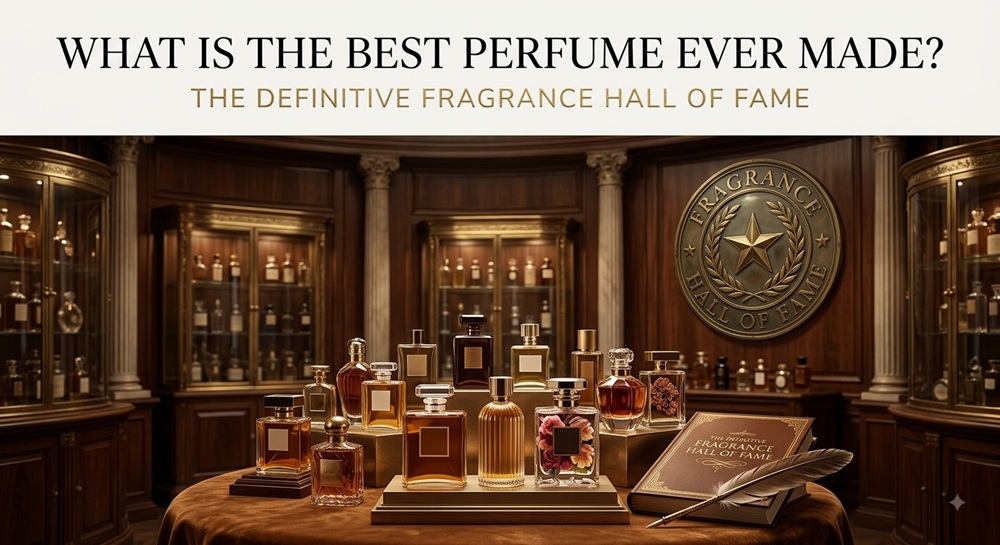
Determining the single “best” perfume ever created is one of the most debated topics in luxury beauty. Perfumery is an intersection of fine art, chemistry, and personal memory. A fragrance that smells transcendent on one person can perform completely differently on another due to individual skin pH, lipid levels, and body heat.
However, when evaluating scents based on historical impact, artistic innovation, sillage, and enduring commercial success, a select group of masterworks consistently rises to the top.
This definitive guide breaks down the greatest perfumes in history, expert evaluations, skin chemistry mechanics, and how to find your own signature masterpiece.
Table of Contents
Key Takeaways
What Makes a Fragrance a Masterpiece?
The Masterpiece Comparison Table
The Top Contenders for the Best Perfume Ever Made
- Chanel No. 5 (Chanel)
- Guerlain Shalimar (Guerlain)
- Guerlain Mitsouko (Guerlain)
- Thierry Mugler Angel (Mugler)
- Frédéric Malle Portrait of a Lady
- Le Labo Santal 33
- Tom Ford Black Orchid
- Maison Francis Kurkdjian Baccarat Rouge 540
- Viktor & Rolf Flowerbomb
- Dior Sauvage
- Calvin Klein Eternity
Iconic Classics & Popular Favorites
What Is the Winner?
10 Reasons Why Choosing a Single “Best” Perfume Is So Difficult
How Your Body Chemistry Transforms Perfume Application
- Skin Hydration & Lipid Density
- Surface pH & Acid Mantle Balance
- Body Heat & Micro-Circulation
- Diet, Metabolic Byproducts & Hormones
- Natural Skin Flora & Microbiome
Frequently Asked Questions
Finding Your Signature Scent
Key Takeaways
The Undisputed Icon: Chanel No. 5 (1921) remains the most historically significant perfume ever created due to its revolutionary use of synthetic aldehydes and modern floral structure.
The Oriental Benchmark: Guerlain Shalimar (1925) set the gold standard for warm amber, vanilla, and citrus compositions.
Skin Chemistry Is Key: Factors such as skin hydration, pH levels, and natural surface oils drastically alter how top and base notes unfold over time.
Subjectivity vs. Industry Consensus: While scent preference is personal, industry critics judge masterpieces by their accord harmony, diffusion, longevity, and structural originality.
What Makes a Fragrance a Masterpiece?
In fine perfumery, a masterpiece is not simply a pleasant blend of pleasing oils. Perfume critics and master perfumers (“noses”) evaluate legendary scents using four core technical criteria:
Structural Accord Harmony: How seamlessly the top notes (initial burst), heart notes (core identity), and dry-down base notes transition over several hours.
Diffusion & Sillage: The scent trail left behind in the air as the wearer moves, without becoming cloying or overwhelming.
Innovation & Originality: Introducing an entirely new olfactory family or utilizing novel raw materials (such as synthetic molecules or rare botanicals).
Timeless Relevance: Maintaining cultural resonance and consumer demand across generations.
The Masterpiece Comparison Table
| Fragrance | House | Release Year | Olfactory Family | Core Profile |
| No. 5 | Chanel | 1921 | Floral Aldehyde | Aldehydes, Ylang-Ylang, Jasmine, Sandalwood |
| Shalimar | Guerlain | 1925 | Amber / Oriental | Bergamot, Iris, Vanilla, Tonka Bean |
| Mitsouko | Guerlain | 1919 | Fruity Chypre | Peach, Oakmoss, Bergamot, Vetiver |
| Angel | Mugler | 1992 | Gourmand Patchouli | Patchouli, Chocolate, Caramel, Cotton Candy |
| Portrait of a Lady | Frédéric Malle | 2010 | Amber Floral / Rose | Turkish Rose, Patchouli, Frankincense, Clove |
| Santal 33 | Le Labo | 2011 | Woody Aromatic | Sandalwood, Cedarwood, Cardamom, Leather |
| Black Orchid | Tom Ford | 2006 | Warm Floral / Gourmand | Black Truffle, Black Orchid, Patchouli, Spice |
| Baccarat Rouge 540 | Maison Francis Kurkdjian | 2015 | Amber Woody | Saffron, Jasmine, Amberwood, Fir Resin |
| Flowerbomb | Viktor & Rolf | 2005 | Amber Floral | Tea, Cattleya Orchid, Centifolia Rose, Patchouli |
| Sauvage | Dior | 2015 | Fresh Aromatic | Calabrian Bergamot, Sichuan Pepper, Ambroxan |
| Eternity | Calvin Klein | 1988 | Floral Green | White Lily, Freesia, Sage, Sandalwood |
The Top Contenders for the Best Perfume Ever Made
1. Chanel No. 5 (Chanel) — The Floral Aldehydic Benchmark
Why it’s a contender: Created in 1921 by master perfumer Ernest Beaux for Coco Chanel, Chanel No. 5 revolutionized modern perfumery. Beaux utilized an unprecedented overdose of synthetic aldehydes—organic compounds that give natural floral extracts an effervescent, sparkling lift.
“A monument of fragrance and the definition of timeless elegance.”
— Luca Turin, Biophysicist & Co-Author of Perfumes: The A-Z Guide
- Top Notes: Aldehydes, Ylang-Ylang, Neroli, Bergamot
- Heart Notes: Jasmine, Rose, Iris, Lily-of-the-Valley
- Base Notes: Sandalwood, Vetiver, Vanilla, Amber, Musk
2. Guerlain Shalimar (Guerlain) — The Crown Jewel of Amber Fragrances
Why it’s a contender: Unveiled at the 1925 International Exhibition in Paris, Shalimar set the gold standard for warm, oriental compositions. Perfumer Jacques Guerlain poured synthetic ethylvanillin into Guerlain’s existing Jicky base, creating a sultry fusion of bright citrus and dark, powdery vanilla.
“Shalimar is an unrepeatable masterpiece of oriental perfumery—an intoxicating fusion of bright citrus and dark, sultry vanilla.”
— Chandler Burr, Former New York Times Perfume Critic
- Top Notes: Bergamot, Lemon, Cedar, Mandarin
- Heart Notes: Iris, Patchouli, Jasmine, Rose
- Base Notes: Vanilla, Tonka Bean, Opoponax, Leather, Amber
3. Guerlain Mitsouko (Guerlain) — The Reference Chypre
Why it’s a contender: Launched in 1919, Mitsouko is widely regarded by industry insiders as the benchmark of technical balance in perfumery. By pairing a crisp oakmoss-and-bergamot chypre structure with a velvety peach lactone, Jacques Guerlain created a scent that is shadowy, mysterious, and deeply sophisticated.
“Every time I am asked to name my favorite fragrance, or the best fragrance ever made… I always answer Mitsouko.”
— Luca Turin, Biophysicist & Co-Author of Perfumes: The A-Z Guide
- Top Notes: Bergamot, Citrus, Jasmine, Rose
- Heart Notes: Peach, May Rose, Jasmine, Ylang-Ylang
- Base Notes: Oakmoss, Vetiver, Spices, Wood Notes, Amber
4. Thierry Mugler Angel (Mugler) — The Pioneer of Gourmand Perfumery
Why it’s a contender: Released in 1992 and composed by Olivier Cresp and Yves de Chirin, Angel created an entirely new scent category overnight: the gourmand. By balancing a massive dosage of sweet ethyl maltol (cotton candy/caramel) against dark, earthy patchouli, Angel broke every rule in commercial perfumery and became one of the most influential formulas of the late 20th century.
“Like a woman in a film who seethes, ‘He’s so annoying!’ and marries him in the end, I returned to smell Angel so many times I had to buy it.”
— Tania Sanchez, Co-Author of Perfumes: The A-Z Guide
- Top Notes: Cotton Candy, Coconut, Cassis, Melon, Jasmine, Bergamot
- Heart Notes: Honey, Red Berries, Blackberry, Plum, Apricot, Peach, Rose
- Base Notes: Patchouli, Chocolate, Caramel, Vanilla, Tonka Bean, Amber
5. Frédéric Malle Portrait of a Lady — The Grand Modern Rose
Why it’s a contender: Created in 2010 by Dominique Ropion, Portrait of a Lady contains an unprecedented concentration of Turkish rose essence (roughly 400 roses per 100ml bottle). Supported by a massive backbone of patchouli, frankincense, and clove, it is widely considered the gold standard of contemporary rose-amber perfumery.
“Dominique Ropion’s masterpiece… a symphonic rose that balances dark woods with sheer, luminous patchouli.”
— Victoria Frolova, Perfume Critic & Founder of Bois de Jasmin
- Top Notes: Rose, Clove, Raspberry, Blackcurrant, Cinnamon
- Heart Notes: Patchouli, Incense, Sandalwood
- Base Notes: Musk, Benzoin, Amber
6. Le Labo Santal 33 — The Defining Niche Scent of a Generation
Why it’s a contender: Composed by Frank Voelkl in 2011, Santal 33 became a global cultural phenomenon. It redefined urban luxury by moving away from traditional florals and sweet accords, offering a dry, smoky mix of Australian sandalwood, papyrus, cardamom, and leather that defined the olfactory landscape of major cities worldwide.
“Santal 33 achieved what very few niche perfumes ever do: it became a genuine cult classic that reshaped what the general public expects from modern woody scents.”
— Victoria Frolova, Perfume Critic & Founder of Bois de Jasmin
- Top Notes: Violet Accord, Cardamom
- Heart Notes: Iris, Ambrox
- Base Notes: Sandalwood, Cedarwood, Papyrus, Leather
7. Tom Ford Black Orchid — The Dark Luxury Disruptor
Why it’s a contender: Debuted in 2006 as Tom Ford’s flagship fragrance under his own brand, Black Orchid introduced a lavish, unisex approach to mass-market luxury. It pairs rare black truffle and dark florals with rich Mexican chocolate and patchouli, producing a dramatic, instantly recognizable presence.
“Black Orchid is a triumph of theatricality in perfumery—rich, dark, unapologetic, and technically brilliant.”
— Chandler Burr, Former New York Times Perfume Critic
- Top Notes: Black Truffle, Ylang-Ylang, Blackcurrant, Bergamot
- Heart Notes: Black Orchid, Floral Notes, Fruity Accords, Spices
- Base Notes: Mexican Chocolate, Patchouli, Vanilla, Incense, Amber, Sandalwood
8. Maison Francis Kurkdjian Baccarat Rouge 540 — The Molecular Sillage Master
Why it’s a contender: Composed in 2015 by Francis Kurkdjian, Baccarat Rouge 540 redefined contemporary niche perfumery. Utilizing an abstract, minimalist blend of ethyl maltol, ambroxan, and hedione, it creates an airy yet immensely diffusive trail of burnt sugar, saffron, and cedarwood that lingers long after the wearer leaves the room.
“Baccarat Rouge 540 has the density of a cloud and the luminosity of a crystal. It is a masterpiece of abstraction.”
— Chandler Burr, Author & Former New York Times Perfume Critic
- Top Notes: Saffron, Jasmine
- Heart Notes: Amberwood, Ambergris
- Base Notes: Fir Resin, Cedar
9. Viktor & Rolf Flowerbomb — The Ultimate Modern Floral Explosion
Why it’s a contender: Launched in 2005 and formulated by Olivier Polge, Carlos Benaim, and Domitille Michalon Bertier, Flowerbomb became a blueprint for 2000s gourmand-floral compositions. It balances rich floral accords (jasmine, freesia, orchid) over a warm patchouli and vanilla base, creating a crowd-pleasing trail with immense longevity.
“Flowerbomb took the explosive floral-gourmand structure and perfected its commercial execution, establishing a benchmark for modern sweet florals.”
— Tania Sanchez, Co-Author of Perfumes: The A-Z Guide
- Top Notes: Tea, Bergamot, Osmanthus
- Heart Notes: Orchid, Jasmine, Rose, Freesia, African Orange Flower
- Base Notes: Patchouli, Musk, Vanilla
10. Dior Sauvage — The Modern Aromatic Titan
Why it’s a contender: Formulated in 2015 by François Demachy, Dior Sauvage reinterpreted classic masculine aromatic compositions for the 21st century. Grounded in a heavy dose of hyper-radiant Ambroxan and crisp Calabrian bergamot, Sauvage became a global phenomenon praised for its projection and versatility.
“It’s a very interesting work on freshness… Sauvage is an impressive exercise in modern perfumery.”
— Victoria Frolova, Perfume Critic & Founder of Bois de Jasmin
- Top Notes: Calabrian Bergamot, Pepper
- Heart Notes: Sichuan Pepper, Lavender, Pink Pepper, Vetiver, Patchouli, Geranium, Elemi
- Base Notes: Ambroxan, Cedar, Labdanum
11. Calvin Klein Eternity — The 90s Clean Floral Pioneer
Why it’s a contender: Created in 1988 by Sophia Grojsman, Eternity defined the shift away from the heavy, animalic spice-bombs of the 1980s toward crisp, green, romantic florals. Built on Grojsman’s signature “hug-me” accord structure, its blend of white lily, freesia, and soft woods influenced an entire decade of fragrance creation.
“Sophia Grojsman’s work on Eternity helped define an entire era of American perfumery with its brilliant, luminous floral architecture.”
— Luca Turin, Biophysicist & Co-Author of Perfumes: The A-Z Guide
- Top Notes: Freesia, Sage, Mandarin, Citrus
- Heart Notes: White Lily, Carnation, Lily-of-the-Valley, Narcissus, Marigold, Rose, Jasmine
- Base Notes: Sandalwood, Musk, Amber, Patchouli, Heliotrope
Other Famous Iconic Classics!
- Versace Bright Crystal: Luminous, uplifting fruity-floral radiance (Yuzu, Pomegranate, Peony, Lotus, Musk).
- Dolce & Gabbana Light Blue: Mediterranean summer in a bottle—crisp lemon, Granny Smith apple, and cedarwood.
- Marc Jacobs Daisy: Charming, youthful floral warmth (Strawberry, Violet Leaves, Gardenia, White Woods).
- Dior Joy: Bright citrus wrapped in optimistic floral warmth (Grasse Rose, Jasmine, Sandalwood, White Musk).
- Giorgio Armani Acqua di Giò: The ultimate fresh marine aromatic classic (Calabrian Bergamot, Neroli, Marine Accords, Cedarwood).
- Calvin Klein CK One: Groundbreaking 90s unisex minimalism (Pineapple, Green Notes, Papaya, Jasmine, Musk).
- Giorgio Armani Sì: Elegant modern feminine chypre with blackcurrant nectar and blonde woods.
- Jimmy Choo by Jimmy Choo: Glamorous, sweet fruity-chypre featuring sweet toffee and patchouli.
- Gucci Bloom: A rich, authentic white floral garden in full bloom (Jasmine, Tuberose, Rangoon Creeper).
- L’Eau d’Issey by Issey Miyake: Pure, aquatic botanical serenity featuring lotus, freesia, and exotic woods.
So, Whats Is the Winner?
If an absolute consensus must be drawn across historical legacy, artistic significance, and sheer industry impact, Chanel No. 5 takes the crown as the ultimate winner.
While modern contenders like Baccarat Rouge 540 rule contemporary niche markets and Dior Sauvage dominates commercial sales, Chanel No. 5 fundamentally transformed perfumery as an industry. Before its introduction in 1921, fragrances were largely single-note floral waters or heavy, animalic oils. Ernest Beaux’s daring use of synthetic aldehydes proved that perfumery could be an abstract art form rather than a simple imitation of nature.
It is the single fragrance that established the modern luxury perfume category, maintained unbroken global relevance for over a century, and remains the primary benchmark against which all historical masterpieces are measured.
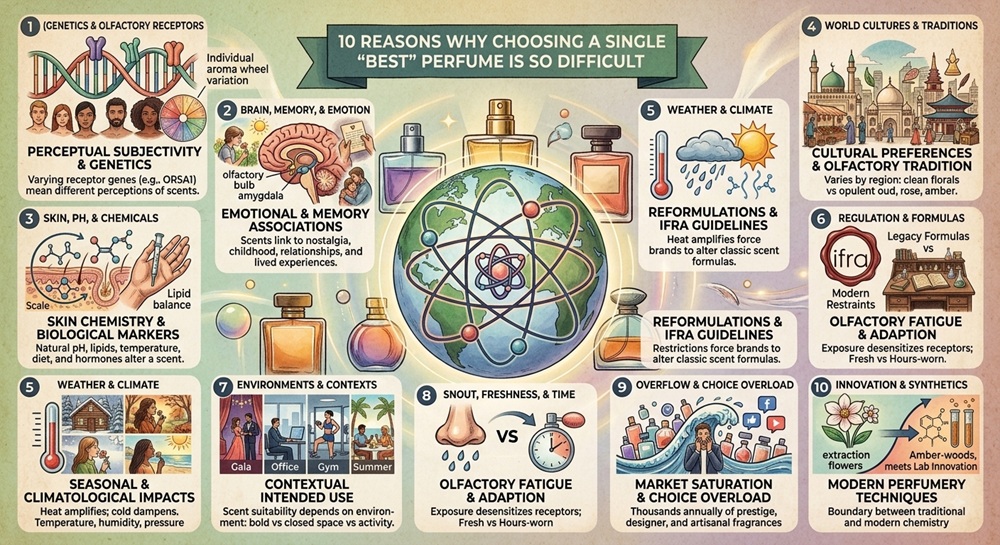
10 Reasons Why Choosing a Single “Best” Perfume Is So Difficult
Finding a single universal winner in perfumery is near-impossible due to these ten fundamental variables:
- Perceptual Subjectivity & Genetics: Human olfactory receptors vary genetically (including differences in specific odorant receptor genes like OR5A1). An aromatic compound that registers as warm, sweet, and comforting to one person can smell sharp, metallic, or soap-like to another.
- Emotional & Memory Associations: The olfactory bulb connects directly to the amygdala and hippocampus—the brain’s emotional and memory centers. A scent’s appeal is intensely linked to personal nostalgia, childhood surroundings, past relationships, and lived experiences.
- Skin Chemistry & Biological Markers: Natural skin pH, lipid balance, body temperature, diet, and even hormone fluctuations alter perfume molecules upon contact, ensuring a scent performs differently on every individual.
- Cultural Preferences & Olfactory Tradition: Scent appreciation varies dramatically across geographic regions. Western markets have historically leaned toward clean florals or fresh citrus, whereas Middle Eastern and South Asian traditions prioritize opulent, resinous accords like Oud, Bakhoor, Rose, and Amber.
- Seasonal & Climatological Impacts: Temperature, humidity, and atmospheric pressure alter how volatile fragrance oils evaporate. High heat amplifies heavy orientals into something overwhelming, while freezing temperatures can cause delicate fresh notes to disappear entirely.
- Continuous Reformulations & IFRA Guidelines: Raw material restrictions from the International Fragrance Association (IFRA) force brands to regularly alter formulas. Replacing vintage components (like natural oakmoss or nitro-musks) means a classic scent from 1990 rarely smells identical to its modern retail bottle.
- Contextual Intended Use: Fragrance requirements depend heavily on the environment. A bold, animalic niche fragrance built for an evening gala is ill-suited for a closed office space, an intensive workout, or a hot outdoor summer brunch.
- Olfactory Fatigue & Adaption: Exposure to strong synthetic fixatives (such as Iso E Super or Ambroxan) temporarily desensitizes human odor receptors. People evaluate scents differently depending on whether they are sniffing them fresh or experiencing them after hours of wear.
- Market Saturation & Choice Overload: With thousands of new prestige, designer, and artisanal fragrances launching annually, tracking down a static “best” is a moving target amidst constant market noise and shifting social media trends.
- The Evolution of Modern Perfumery Techniques: The boundary between traditional floral extraction and modern synthetic chemistry is constantly moving. Novel aroma-chemicals (like modern amber-woods and gourmand lactones) continuously change public standards for what constitutes a “good” scent trail (sillage).
How Your Body Chemistry Transforms Perfume Application
Applying perfume is not merely spraying a scent—it triggers a live chemical reaction on your skin. The moment perfume leaves the atomizer, its volatile alcohol base evaporates, leaving concentrated oils to interact directly with your biology.
Here are the 5 key body chemistry factors that dictate how a fragrance unfolds on your skin:
1. Skin Hydration & Lipid Density
Dry skin lacks the natural sebum and lipids required to anchor volatile fragrance molecules. On dry skin, top notes evaporate rapidly (“flashing off”), reducing overall longevity. Hydrated skin acts as a barrier that locks oil molecules to the surface, significantly slowing down the evaporation curve and extending wear time.
2. Surface pH & Acid Mantle Balance
Human skin naturally maintains a slightly acidic pH (typically between 4.5 and 5.5). Variations in your acid mantle alter how synthetic and natural aromatics break down. Slightly higher acidity can accentuate sharp, citrus, or green accords, whereas lower acidity allows deep base notes like vanilla, sandalwood, and amber to bloom more prominently.
3. Body Heat & Micro-Circulation
Fragrance molecules are thermally activated. Areas with higher surface temperatures—specifically pulse points where major blood vessels sit close to the skin (wrists, neck, inner elbows, chest)—act as micro-diffusers. Higher localized body heat increases the kinetic energy of the scent oils, pushing the fragrance outward into a larger ambient trail (sillage).
4. Diet, Metabolic Byproducts & Hormones
What you consume directly affects the volatile organic compounds secreted through your sweat glands and pores. Diets high in red meat, heavy spices (like garlic and cumin), or alcohol subtly alter your natural baseline scent. Similarly, hormonal shifts (such as stress cortisol spikes or cyclical changes) influence oil production and adjust how perfumes dry down.
5. Natural Skin Flora & Microbiome
Your skin hosts a unique ecosystem of microorganisms and bacteria. As these microbes interact with the natural oils your body produces—and subsequently mix with the botanical and synthetic compounds in your perfume—they create subtle chemical side-products. This individual microbiome profile is the ultimate reason why no perfume smells 100% identical on two different people.
Frequently Asked Questions
1. What is the most famous perfume in history?
Chanel No. 5 is universally recognized as the most famous perfume in history. Since its release in 1921, it has remained a top-selling luxury fragrance worldwide and an enduring cultural icon.
2. What is the difference between Eau de Toilette (EdT) and Eau de Parfum (EdP)?
The primary difference is scent oil concentration:
- Eau de Toilette (EdT): 5% to 15% aromatic oils; lasts 3 to 5 hours. Ideal for daily, lighter wear.
- Eau de Parfum (EdP): 15% to 20% aromatic oils; lasts 6 to 8+ hours. Offers richer heart and base notes.
3. Why do some perfumes smell different today than they did decades ago?
Fragrance formulas are updated over time due to reformulations. Regulations by the International Fragrance Association (IFRA) frequently restrict or ban certain raw materials (such as natural oakmoss, real deer musk, or specific synthetic fixatives) due to allergen safety, necessitating subtle adjustments by master perfumers.
4. How long does an unopened bottle of perfume actually last?
Stored correctly in a cool, dark environment away from humidity and direct sunlight, an unopened bottle of perfume can last 3 to 5 years—and often much longer for resinous, oil-heavy compositions. Light, heat, and air exposure are the primary triggers for chemical degradation and sour top notes.
5. Why can’t I smell my own perfume after a few hours?
This phenomenon is known as olfactory fatigue or nose-blindness. Your brain naturally filters out constant, non-threatening ambient smells so your olfactory system can stay alert to new environmental scents. Even if you can no longer smell your perfume, those around you can still perceive your sillage.
6. Should you rub your wrists together after spraying perfume?
No, you should never rub your wrists together. The friction creates thermal energy that breaks down volatile top notes faster, causing delicate top notes (like citrus or light florals) to burn off prematurely and altering the master perfumer’s intended fragrance transition.
Finding Your Signature Scent
While industry experts and historians point to Chanel No. 5 as the ultimate masterpiece of perfumery, the best perfume for you is the one that aligns with your personal style, skin chemistry, and confidence.
Rather than buying full bottles based on reputation alone, explore discovery sets, test scents directly on your skin over a full 8-hour wear period, and discover which olfactory family speaks to you.
