




Blog
What Is Women’s Perfume? History, Fragrance Notes & Gender Differences

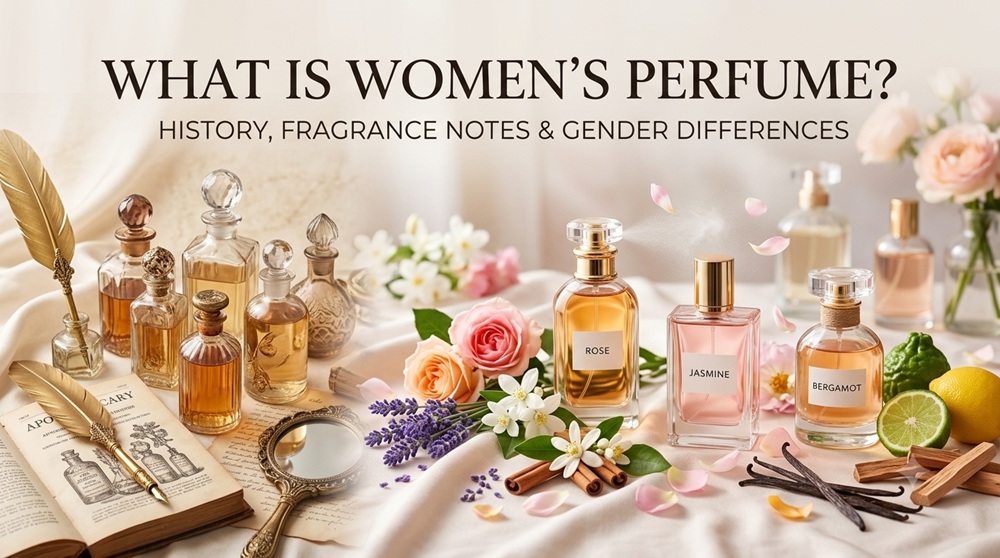
Women’s perfume is a crafted blend of aromatic essential oils, fixatives, and solvents designed to enhance personal scent. While modern perfumery historically associated women’s fragrances with light floral, fruity, and sweet notes, today’s landscape spans a wide spectrum—from delicate botanicals to rich, woody, and resinous compositions.
Understanding Women’s Perfume: Definitions & Ingredients
Women’s perfume is a carefully crafted blend of fragrant essential oils, aroma compounds, alcohol, and water designed to give the body a pleasant, lasting scent. Historically associated with floral, sweet, and delicate accords, modern women’s fragrances range from deep woody tones to vibrant citrus blends.
Table of Contents
Key Takeaways
The History of Women’s Fragrance
Fragrance Structure & Concentrations
Women’s Perfume vs. Men’s Cologne (Comparison Table)
Frequently Asked Questions (FAQ)
Wrap Up
Key Takeaways
- Ancient Roots: Perfumery dates back over 4,000 years to ancient Egypt and Mesopotamia, where aromatic oils were used in sacred rituals, medicine, and personal grooming.
- The Fragrance Pyramid: All perfumes consist of top, heart (middle), and base notes that evaporate at different rates to create a dynamic scent profile.
- Gender Distinctions: Traditional gender markers in fragrance are based on cultural marketing and classic note pairings rather than physical or chemical limitations.
- The Unisex Evolution: Modern perfumery increasingly emphasizes gender-neutral and niche scents, focusing on individual skin chemistry and personal preference.
The History of Women’s Fragrance: Ancient Rituals to Modern Fine Perfumery
1200 BCE — Ancient Mesopotamia & Egypt
The earliest recorded perfumer was a Mesopotamian woman named Tapputi, who distilled botanicals with resins. In ancient Egypt, scented unguents made from frankincense, myrrh, and lily were central to spiritual ceremonies, high-society beauty routines, and funerary practices.
100 BCE – 1000 CE — Greco-Roman & Islamic Innovations
Greek and Roman societies adopted perfumed oils for bathhouse culture and status symbols. Later, Persian physician and chemist Avicenna (Ibn Sina) perfected steam distillation, making high-purity floral essential oils (such as rose water) possible.
1400s – 1700s — The Italian Renaissance & Grasse, France
Perfumery surged in Renaissance Europe, led by Italian court culture. Catherine de’ Medici brought personal perfumers to France, establishing Grasse as the world capital of leather tanning and floral fragrance extraction.
1880s – Present — The Synthetic Revolution & Modern Houses
The introduction of synthetic aroma chemicals (such as coumarin and vanillin) in the late 19th century allowed perfumers to create complex, long-lasting accords. Iconic releases like Chanel No. 5 (1921) introduced aldehydes, forever altering modern fine fragrance design.
Fragrance Structure: Concentration Levels & Note Architecture
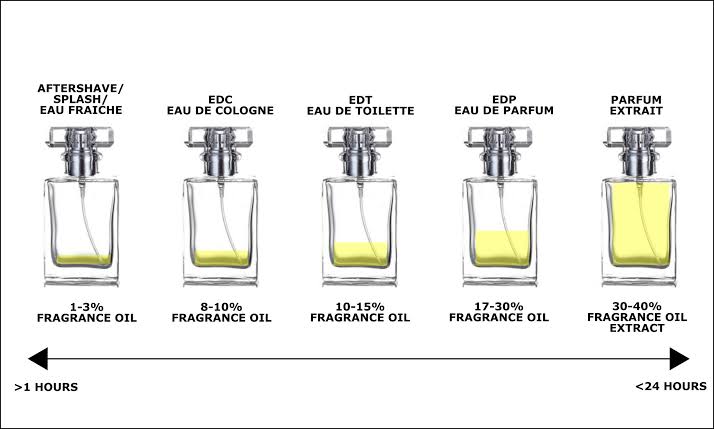
Understanding perfume requires looking at two technical factors: concentration (oil-to-alcohol ratio) and olfactory structure (evaporation rates).
Fragrance Concentrations Explained
| Concentration Type | Aromatic Oil % | Average Longevity | Common Use Case |
| Parfum / Extrait | 20% – 30% | 8+ Hours | Evening wear, rich & intimate sillage |
| Eau de Parfum (EDP) | 15% – 20% | 5 – 8 Hours | Daily wear, strong heart & base persistence |
| Eau de Toilette (EDT) | 5% – 15% | 3 – 5 Hours | Daytime/office, emphasis on crisp top notes |
| Eau de Cologne (EDC) | 2% – 4% | 2 Hours | Refreshing splash, dominant citrus top notes |
The Fragrance Pyramid
Perfumes are composed in three distinct layers that unfold over time as the solution interacts with heat and skin chemistry:
- Top Notes (Head Notes): The initial scent you smell upon spraying. These light, volatile notes—such as citrus, light fruits, and fresh herbs—last for the first 5 to 15 minutes.
- Heart Notes (Middle Notes): The core identity of the fragrance that emerges after top notes fade. Common heart notes in women’s perfume include jasmine, rose, ylang-ylang, and peachy fruits, lasting between 2 to 4 hours.
- Base Notes: The foundation of the scent that grounds the fragrance and anchors it to your skin. Composed of rich ingredients like vanilla, amber, musk, sandalwood, and patchouli, base notes last anywhere from 4 to 8+ hours.
Women’s Perfume vs. Men’s Cologne: What’s the Difference?
While both women’s perfume and men’s cologne consist of aromatic compounds blended with alcohol and water, key differences stem from fragrance composition, marketing intent, oil concentration, and performance dynamics.
| Feature / Attribute | Women’s Perfume (Traditional) | Men’s Cologne (Traditional) | Unisex / Gender-Neutral Fragrances |
| Primary Olfactory Families | Floral, Soft Floral, Fruity, Gourmand (sweet/vanilla) | Woody, Aromatic Fougère, Leather, Fresh Citrus | Amber, Woody-Floral, Green/Herbal, Citrus-Resin |
| Common Core Notes | Jasmine, Rose, Peony, Peach, Vanilla, Tuberose | Cedarwood, Vetiver, Oakmoss, Bergamot, Black Pepper | Santal, Bergamot, Ambergris, Iris, Cardamom |
| Typical Concentration | Mostly Eau de Parfum (EDP) or Eau de Toilette (EDT) | Mostly Eau de Toilette (EDT) or Eau de Cologne (EDC) | Varies (Predominantly EDP or Parfum Extrait) |
| Sillage & Projection | Moderate to High (designed to radiate soft trail) | High Initial Projection (fades to clean proximity) | Varies by note density and oil concentration |
| Bottling & Aesthetics | Curved glass, delicate glasswork, pastel/clear hues | Angular structures, opaque/dark glass, metallic caps | Minimalist apothecary-style bottles, neutral labels |
| Marketing Narrative | Sensuality, romance, elegance, self-expression | Confidence, ambition, vigor, stoicism | Artistry, raw ingredient focus, personal identity |
| Skin Interaction Profile | Emphasizes sweetness and warmth on warmer pulse points | Emphasizes fresh, crisp, or dry woody tones | Formulated to adapt dynamically to natural skin pH |
Frequently Asked Questions
What is the main difference between perfume and cologne?
The primary difference lies in the fragrance oil concentration. Perfume (specifically Eau de Parfum) typically contains 15% to 20% concentrated aromatic oils, providing 5 to 8 hours of longevity. Cologne (Eau de Cologne) contains 2% to 4% fragrance oil, resulting in a lighter scent that lasts around 2 hours.
Can a man wear women’s perfume?
Yes. Fragrance chemistry does not contain biological gender. Scent preference is entirely personal, and how a fragrance smells depends on individual body chemistry, skin pH, and temperature. Many modern men wear classic “feminine” notes like rose, jasmine, and vanilla.
What makes a perfume last longer on the skin?
Fragrance longevity depends on concentration level (Parfum lasts longer than EDT), note architecture (heavy base notes like amber and sandalwood last longer than citrus), and skin hydration. Applying perfume to moisturized skin or over an unfragranced lotion helps slow down evaporation.
What are top, heart, and base notes in women’s fragrance?
Fragrance notes represent the stages of evaporation:
- Top Notes: The initial scent noticed immediately upon spraying (lasts 5–15 minutes).
- Heart Notes: The main character of the fragrance that emerges as top notes fade (lasts 1–4 hours).
- Base Notes: The deep, underlying foundation that anchors the perfume (lasts 6–12+ hours).
Why does the same perfume smell different on different people?
Perfume reacts with individual skin chemistry, including natural oils, skin pH balance, diet, temperature, and moisture levels. These factors subtly alter how fragrance compounds evaporate, creating a unique variation of the scent on each wearer.
What is the best way to apply women’s perfume for maximum longevity?
Apply perfume directly to pulse points—such as the wrists, neck, behind the ears, and inside the elbows—where blood vessels are closest to the skin surface, generating gentle warmth. Avoid rubbing your wrists together after spraying, as this friction breaks down top-note molecules prematurely.
Wrap Up
Women’s perfume has evolved from ancient sacred rituals in Mesopotamia and Egypt into a dynamic form of personal expression and artistry. While commercial trends historically divided scents into gendered categories—pairing soft florals and fruits with women, and dry woods with men—modern perfumery is increasingly breaking down these boundaries.
Understanding fragrance concentrations (EDP vs. EDT) and the three-tiered note pyramid empowers you to select fragrances that match your personal skin chemistry, lifestyle, and aesthetic preferences. Whether you gravitate toward classic floral accords, rich orientals, or modern unisex woods, the best fragrance is simply the one that makes you feel confident.
Explore Authentic Women’s Fragrances in South Africa
Looking for your next signature perfume? Browse Scent Republic’s full collection of luxury women’s perfumes and enjoy fast delivery across South Africa.
